
ALEP Gives Evidence to Parliamentary Select Committee on Proposed Commonhold Reforms
Mark Chick calls for phased implementation and fuller visibility of proposed legislative changes
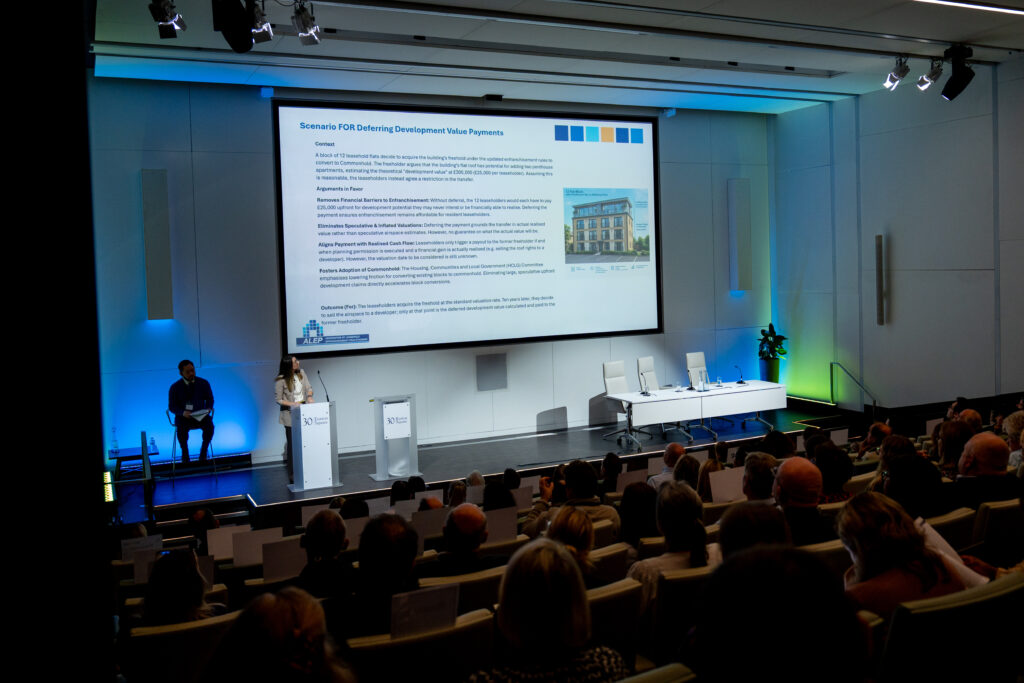
Mark Chick, director of the Association of Leasehold Enfranchisement Practitioners (ALEP) gave oral evidence to the Housing, Communities & Local Government Select Committee on Tuesday as part of the government’s scrutiny of the Draft Commonhold and Leasehold Reform Bill.
Appearing alongside representatives from the RICS (fellow ALEP Member Vanessa Griffiths of Knight Frank) and the Law Society, (represented by Philip Freedman KC from Mishcon de Reya) he addressed a number of the legal issues connected with conversion to commonhold and the wider practicalities of making a reformed commonhold system work.
The need for a complete legislative picture
In his evidence, Mark Chick said ALEP supports the government’s intention to reform leasehold and reinvigorate commonhold, but argued that the process must be handled carefully.
A central point raised in the session was the continuing overlap between the Draft Commonhold and Leasehold Reform Bill and the Leasehold and Freehold Reform Act 2024 (LAFRA), many of whose key provisions remain unimplemented.
Mark Chick repeated the Committee’s request to see the proposed amendments to LAFRA (referred to in Matthew Pennycook’s letter to the committee of 12 February 2026), which indicated that changes would be brought forward when the new bill is introduced to Parliament.
Mark says, “ALEP’s position is that these proposed amendments should be available now so the draft bill can be considered in full. Without this context, there is a risk that Parliament is being asked to scrutinise an incomplete legislative framework, even though the success or failure of the proposed reforms will depend heavily on how the wider valuation and conversion mechanisms operate in practice.”
Conversion remains the crucial test
Mark explains that the difficulty in implementation will primarily revolve around conversion of existing properties:
‘Whilst the draft bill puts forward what we would describe as a significantly improved model of commonhold, ALEP believes many of the most important questions that will relate to the downstream implementation remain tied to conversion.
“That includes the valuation mechanism that will apply not only to enfranchisement, but also when non-participating leaseholders later seek to buy into the commonhold under the rights envisaged in section 52 of the draft bill.
“This is still to be determined through future regulations. This leaves a key part of the future system for conversion after enfranchisement unresolved and at risk of becoming caught up in the same legal and technical difficulties previously identified by the Law Commission in its work on participation rights. In our view primary legislation will be needed to deal with these aspects.”
A phased approach
ALEP, together with the Law Society and RICS, told the Committee that a phased approach to implementation is likely to be the most workable route.
In ALEP’s view, if commonhold reform is to succeed, the first stage should focus on new-build property. That would allow developers, lenders and the wider market to become familiar with commonhold as an asset class before more complex issues relating to existing leaseholders, legacy stock and valuation on conversion are brought into play.
The evidence also noted that these questions sit alongside the proposed ban on the creation of new leasehold flats, which adds another important layer to the debate.
Further scrutiny welcomed
In conclusion, Mark Chick said, “ALEP welcomes the next phase of the Select Committee’s inquiry, including further evidence from lenders and continued legislative scrutiny of the draft Bill.
“We look forward to continuing to work with the MHCLG on the development of the draft legislation and its wider roll-out of commonhold.”