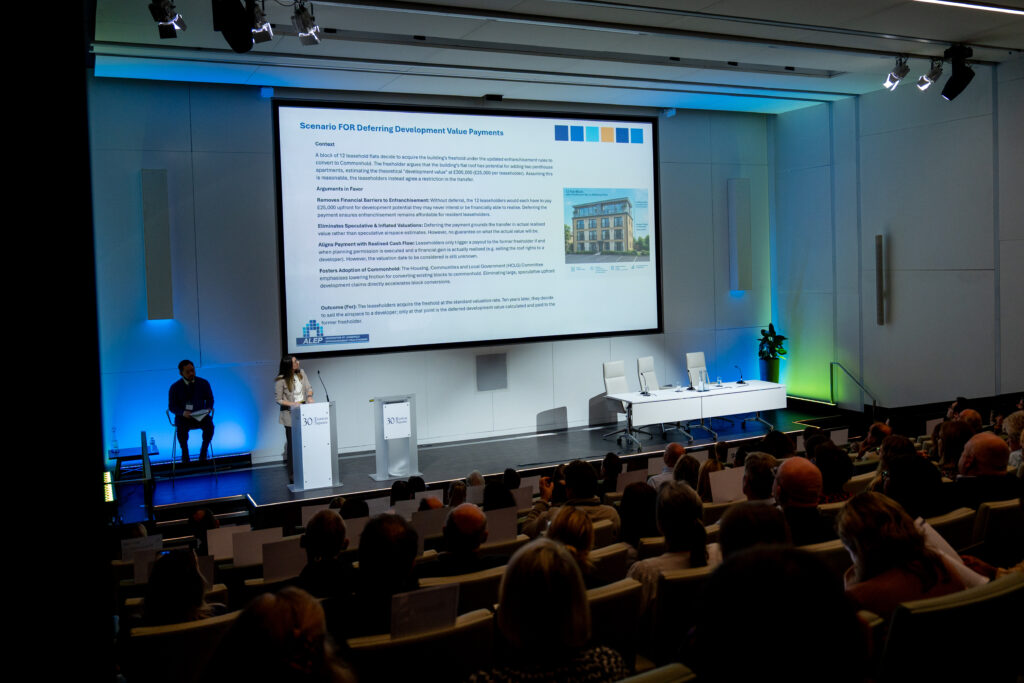
Say ALEP members at annual conference
The government faces important choices about how much leaseholders will pay to extend their leases or buy their freeholds, the Association of Leasehold Enfranchisement Practitioners (ALEP) has said following the closure of the enfranchisement valuation rates consultation on 21 October.
Live polling at ALEP’s annual conference highlighted support among participating delegates for recognising differences between leases, alongside divided views on how the valuation framework should be updated.
The consultation concerned two key percentages used to calculate the price payable to a freeholder. Although technical, these figures can materially affect the amount a leaseholder must find.
The first, the deferment rate, is used to calculate today’s value of the freeholder’s right to receive the property back when the lease expires. The second, the capitalisation rate, converts future ground rent payments into a present-day lump sum. All else being equal, a lower rate produces a higher value for the relevant freeholder interest.
ALEP Director Mark Chick said: “These rates may look like a technical detail, but they help determine the price someone pays to extend their lease or acquire their freehold. The idea is that prescribing rates should make calculations more predictable and reduce the scope for some disputes. The challenge is to establish an approach supported by evidence that also recognises differences which materially affect value.
“These rates are currently set by case law and in the case of the deferment rate there is generally more scope for negotiation. With the proposed ground rent cap and also the assumed cap in the LAFRA valuation of 0.1% of the property’s value, the impact of the capitalisation rate is already set to be somewhat diminished.
“The government hopes that prescribing rates will be part of the process of making enfranchisement ‘cheaper and easier.’ In that context it sounds like it means that the government favours moves towards adjusting the rates in favour of leaseholders, but their eventual position remains to be seen….”
During the conference session led by Vanessa Griffiths and Adrian Hau, 75% of respondents supported a distinct prescribed approach for leases with between five and 20 years remaining. Just 10% favoured using the same benchmark as for longer leases, while 15% were undecided.
The distinction concerns how soon the freeholder’s interest becomes available. Receiving a property back in ten years represents a different investment proposition from receiving it many decades later.
On the broader method for setting deferment rates, updating the established Sportelli framework attracted the largest share of responses, at 37%. Retaining its existing benchmarks received 25%, while 9% preferred an alternative methodology and 28% wanted more evidence.
For capitalisation rates, 45% favoured three rates differentiated by the way ground rents are reviewed, compared with 14% supporting one rate for all rent-review types. A further 17% preferred an alternative structure and 24% were undecided.
This question reflects differences between income streams: a fixed ground rent and one that increases periodically do not necessarily have the same investment characteristics.
Mark Chick added: “The polling shows where participating delegates saw a case for differentiation, but also where opinion remained divided. Delegates at conference did not identify a single percentage that government should adopt, and that is perhaps no surprise. With the consultation closed, the Government’s task is to assess the evidence and explain how its chosen approach will operate alongside the wider enfranchisement reforms. Leaseholders and their advisers will also need clarity about implementation and the treatment of claims already underway. In addition, the scope for further challenge on human rights grounds to these new rates (whatever they will be) certainly cannot be discounted.”